Happy holidays, good luck, don't work too hard
Burnout is a thing. Don't forget to recharge.
I just saw the Good Luck, Have Fun, Don’t Die trailer. I really wanted to use the title for a post, alas… it wouldn’t work. But it reminded me how important it is to take care of ourselves.
These past few months were very busy. I had two projects compounded on top of each other — one, a client modernization effort; the other, a new release of an analytics tool we use with our customers. It was more than I like to take on at one time and, yes, I got a bit burned out.
Which is a good reminder — prioritize your well being!
Work will always be there. Life will pass you by.
Recharge in Malaga
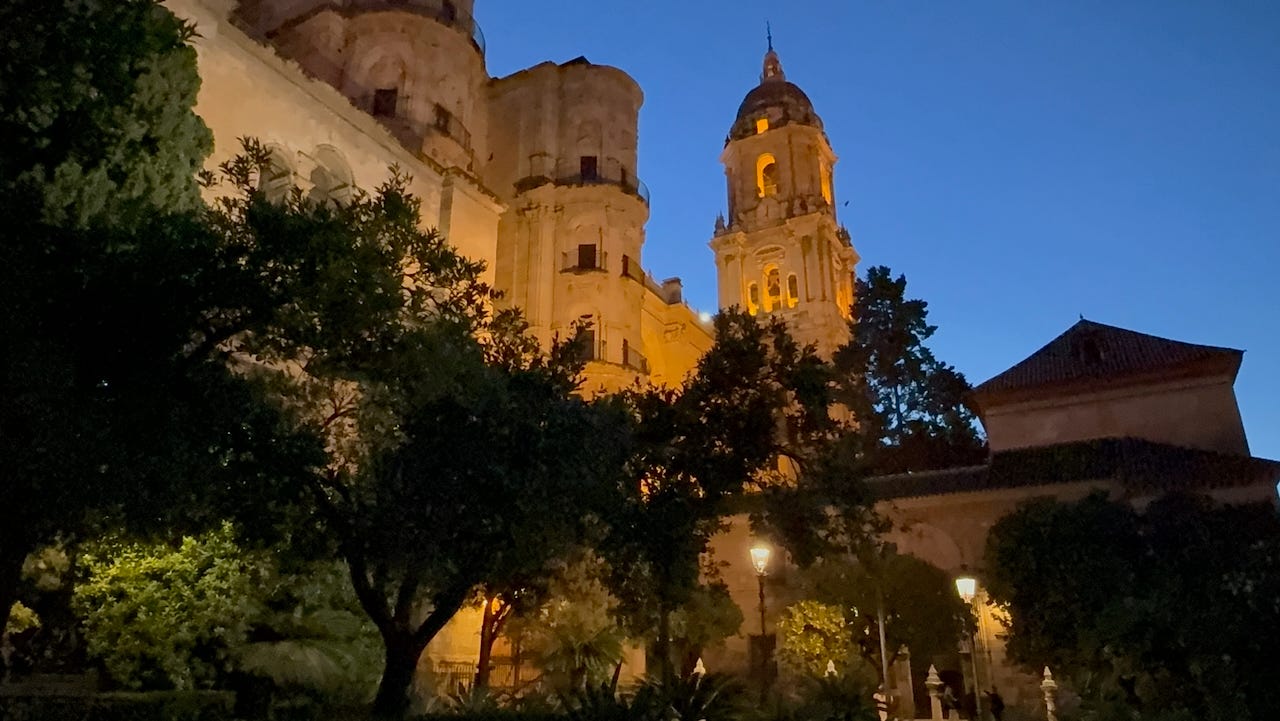
After getting all the work out of the way, we took some time to recharge: a few weeks off in Malaga.

It was the first time we visited this part of Spain, and we enjoyed every bit of the trip: from the fantastic Spanish cuisine, to meeting a few of our friends, and exploring the city and the Alcazaba.
One of the Malaga’s most striking features is the Alcazaba, a palatial fortification that dates back to the 11th century.

The complex used to stretch from the central Alcazaba all the way to the top of the mountain (above). Today, the entire structure is split into two halves, the fortress and the palace — both are open to visitors.

The Alcazaba itself is an amazing fortress — impenetrable stone walls, creating layered fortifications within fortifications. Invaders would face the impossible task of navigating narrow passages, fighting around tight angled turns blocked by iron-fortified doors, and fending off attacks from defenders placed above them.

The Alcazaba was an entire city, with its own fruit trees, farms and a source of clean water. Even so, it eventually fell to the Catholic Monarchs (Ferdinand and Isabella) in 1487 after a grueling siege: after months of resistance, the Muslim governor, Hamet el Zegrí, withdrew his forces to the Gibralfaro Castle, leading to the city’s surrender on August 18.

Malaga has so much amazing history.
It was founded 2,800 years ago, around 800 BC by the Phoenicians. Named “Malaka” originally, it’s one of Europe’s oldest cities with a rich history — shaped by Phoenicians, Greeks, Romans, Carthaginians and Moors long before its conquest by Christians in 1487.
You can still see evidence of that history. Just outside the Alcazaba lies a Roman theatre that dates back to the 1st century, AD.

Wandering the Caminito del Rey
A ways outside the city is the Caminito del Rey (the “King’s little path”), a fantastic hike through a spectacular, restored cliffside walkway through the Gaitanes Gorge, famous for its narrow, high-up boardwalks and suspension bridge.

Once known as “the world’s most dangerous path,” it’s now a safe, popular tourist attraction offering breathtaking gorge views.
Along the path you’ll find olive trees, Aleppo pines, and goats scampering freely over the rocky cliff faces.

Originally built for hydroelectric plant workers in the early 1900s and named after King Alfonso XIII’s 1921 visit, the Caminito del Rey is a one-way, 8km-long route featuring suspended walkways 100m above the river.
Enjoy your holidays!
As the winter holidays approach, I hope you’ll take time to prioritize family and your own well being — and find your own way to recharge.
Happy holidays from Spain!
Up next…
Over the holidays I’ll be getting back into the swing of writing on a regular basis. Next up will be the second part of my series on data pipeline architecture. The next chapters of the Delivery Playbook are in the works, too: 3.5 Modeling and 3.6 Specification. These chapters continue the software build lifecycle by adding fidelity to technical designs and specifications.


