
Navigating the playbook
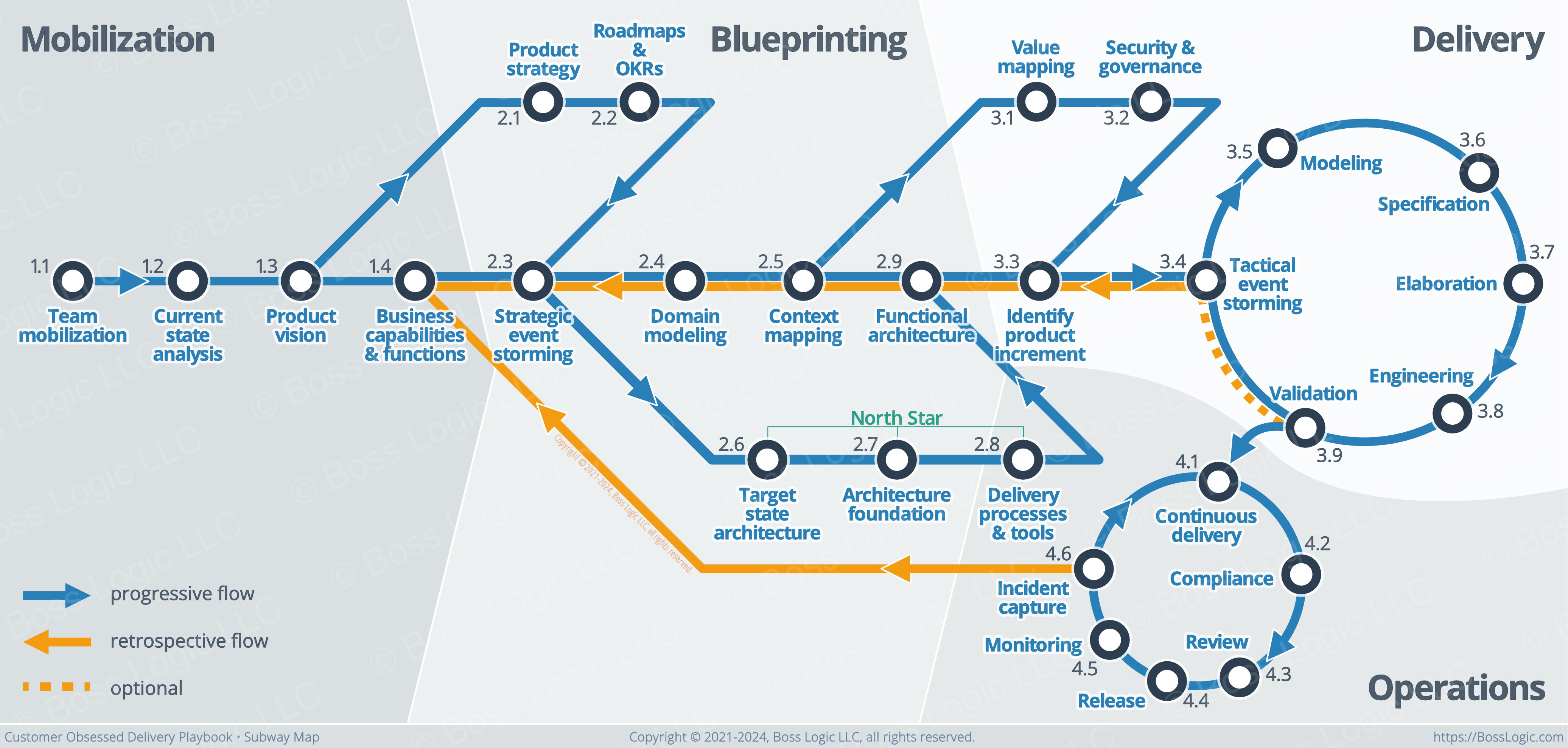
The playbook is organized into four sections that group like-kinds of activities together. These groups describe different focus areas in the software development lifecycle, visible above in the subway map.
Mobilization. Activities conducted in the run-up to a project, such as team selection, onboarding, kickoff calls, and problem space analysis.
Blueprinting. Implementation of overarching architectural designs, and establishing a target state architecture.
Delivery. Creating detailed technical specifications, engineering work, and building a product increment that is ready for production.
Operations. Ensuring security and compliance is “fit-for-purpose,” delivering the product increment, and capturing feedback into the design process of future increments.
Across the four phases are 28 distinct functional areas. Each functional area addresses a key step in the design and delivery lifecycle. Each step depends on the output of previous steps, and generates inputs for downstream steps.
Reading the “subway map”
The playbook is visually represented in the following “subway map.” As you can see from the map, there’s a flow that progresses from early stage activities (Mobilization) to later stage activities (Delivery, and Operations).
Refer back to the subway map if you need to know where you are in the flow. The map also helps clarify what inputs are needed at each activity, and what outputs you will produce in a given step.
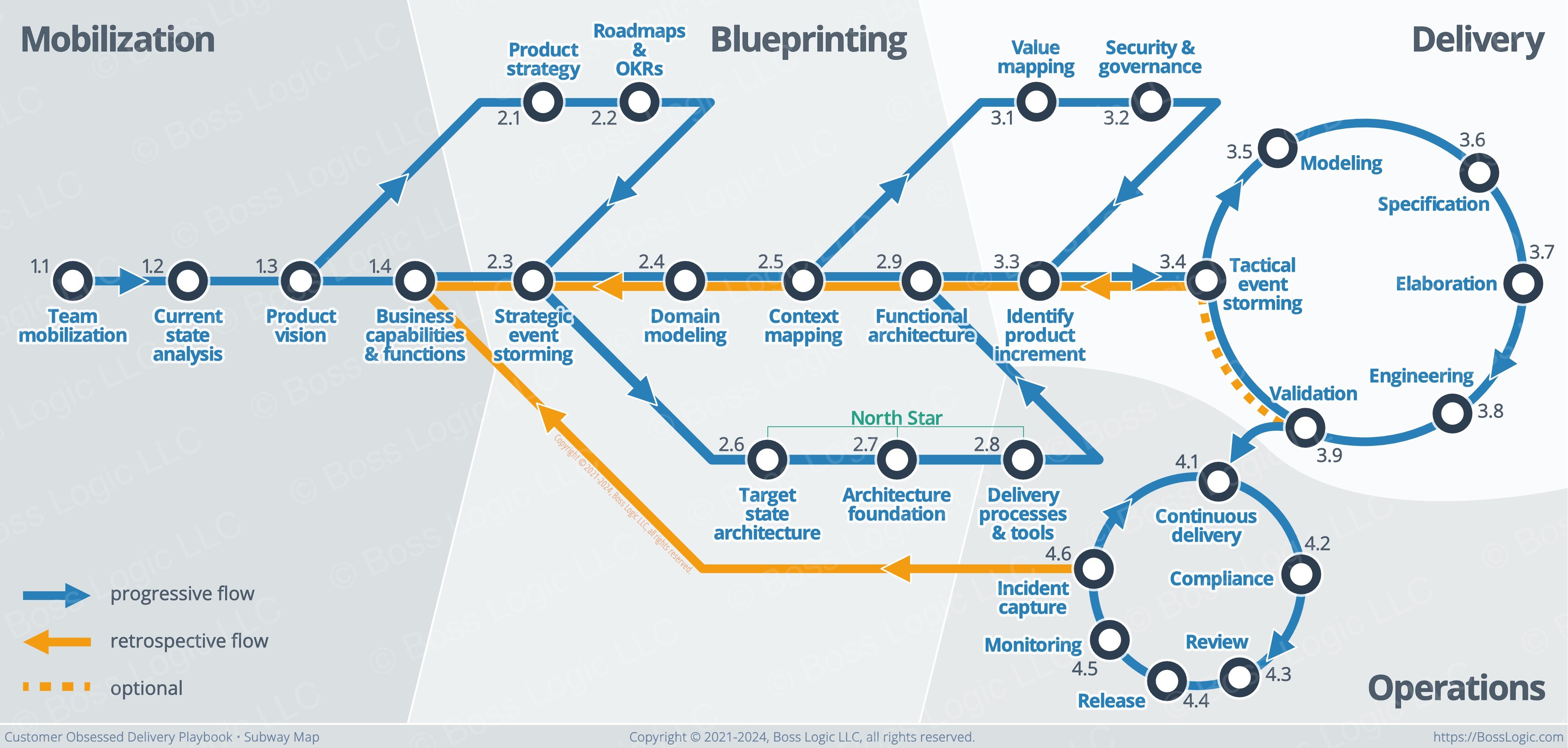
For example, if you are at the “strategic event storming” subway stop, the map shows us that you’ll need a product vision, roadmaps, and OKRs before proceeding. It also shows that the next activity will be either domain modeling or target state architecture. (In fact, you can parallelize and do both at the same time).
The getting started chapter provides details on how to read and follow the subway map.
Execution tends to be fairly linear, despite the branches in the map. Each chapter of the playbook will make it clear where you are, and what activities follow on from there.
What to bookmark
The Delivery Playbook offers a lot of resources. Finding your way can be a little intimidating at first. Here are a few bookmarks to get you started:
Everything you need to know is a complete table of contents
The Delivery Playbook online reference (hosted on GembaKai.us)
As a Customer Obsessed Engineering subscriber, you get access to the online reference and its interactive subway map. Give it a try!
Publication details
Accessing the Customer Obsessed Delivery Playbook online
Paid subscribers can access the Customer Obsessed Delivery Playbook online, either from this link or by clicking ‘Playbook’ in the menu bar on the Customer Obsessed Engineering home page.
If you’re a free subscriber, you will have access to previews of most chapters, as well as select full chapters as they are released.
Can my organization get the complete Customer Obsessed Delivery Playbook?
Yes, absolutely! Check out the colophon for details on options available to your organization.
Can I expense my subscription?
You bet! I think that’s a great idea. If you need a starting point, try reaching out to your manager with this template.
And by the way, there are fantastic group discounts. Maybe your company wants to sponsor your whole team?
To learn more about programs for your organization, check out the colophon.
If you find Customer Obsessed Engineering and the Playbook valuable, please share it with your friends and coworkers.